


Invisalign Gdańsk
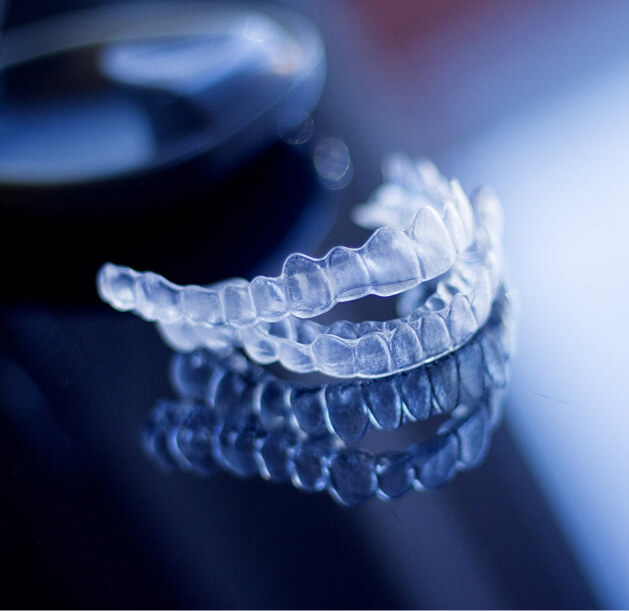
Table of contents
- Invisalign Aligners
- What is Invisalign?
- Advantages of Invisalign Aligners
- Orthodontic Treatment – Step by Step
- Invisalign vs. Traditional Braces
Invisalign Aligners
Invisalign orthodontic aligners are a modern and effective solution that allows the doctor to correct a patient’s tooth alignment without the need for traditional braces with brackets and bands.
Invisalign aligners are designed for patients who care particularly about the aesthetics of their smile and want their orthodontic appliance to remain virtually invisible to others. Similar to
Invisalign, the Clear Aligner system is ideal for individuals wishing to treat diastema, among other issues.
What is Invisalign?
The Invisalign system consists of clear silicone aligners that generate controlled force to move teeth and correct malocclusion.
These aligners are effective for both minor and more complex orthodontic issues.
One of their biggest advantages, beyond their proven effectiveness, is their complete discretion. They are nearly invisible to both the patient and others, avoiding any psychological discomfort.
In short, Invisalign is the most advanced aligner system in the world, making it easy and comfortable to achieve your dream smile.
Advantages of Invisalign Aligners
This system revolutionized orthodontics by combining modernity, aesthetics, and comfort while delivering excellent treatment outcomes.
Aligners are especially recommended for patients who value discretion. Unlike metal braces, Invisalign aligners are free of brackets and wires, making them invisible and gentle on gums and oral mucosa—reducing the risk of irritation.
The removable nature of aligners adds to comfort, allowing patients to eat and maintain oral hygiene easily—thus reducing the risk of cavities.
Another innovation is full personalization: treatment is tailored to each patient’s specific needs, often yielding faster results compared to conventional braces.
Orthodontic Treatment – Step by Step
Treatment with Invisalign begins with a professional consultation, where the orthodontist evaluates the patient’s smile and discusses goals.
A 3D intraoral scan (no impressions needed) is taken, and a detailed treatment plan with a digital smile simulation is created—allowing the patient to see results before starting.
At the next visit, the patient receives their first set of aligners and detailed usage instructions.
Follow-up appointments every few weeks ensure progress tracking and real-time adjustments.
After active treatment, the retention phase begins to maintain results and preserve the beautiful smile long-term.
Invisalign vs. Traditional Braces
Both systems have specific uses and indications.
Clear aligners like Invisalign are ideal for patients who prioritize appearance and daily comfort. They’re effective for cases like mild crowding or minor misalignment.
Aligners deliver results with minimal disruption to oral tissues and high patient comfort.
Traditional braces may be needed in more complex orthodontic cases requiring stronger forces.
Regardless of the case, a skilled specialist can always choose the best solution to help the patient achieve the desired outcome.